
L Plates to P Plates Victoria: Victoria’s Graduated Licensing System Explained
Book Your Lesson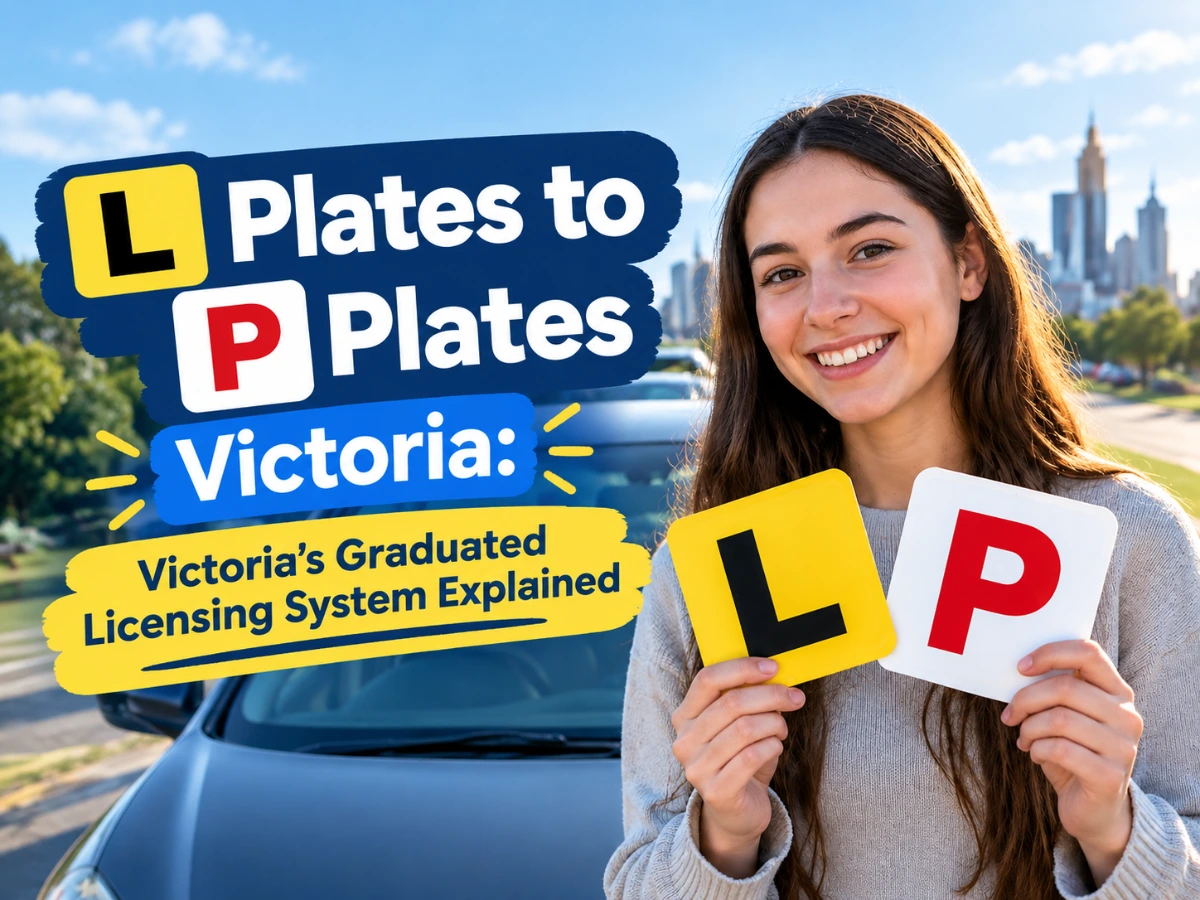
Summarize this post
Getting a driver’s licence in Victoria isn’t a single event. It’s a journey through stages, each one designed to hand you more independence as you prove you can handle it safely. For most new drivers, that journey runs from L plates, through red P1 plates, to green P2 plates, and finally to a full licence with no restrictions at all.
It sounds like a lot of steps. In practice, it’s a lot more straightforward once you see it laid out properly. So let’s walk through it, stage by stage.
The Big Picture: Victoria’s Four Licensing Stages
Victoria’s system exists for one reason: driving is a skill that genuinely takes time to build, and young or new drivers are statistically more at risk in their first few years behind the wheel. The graduated system spaces out that risk, rather than handing someone full, unrestricted driving privileges the moment they pass a single test.
Here’s the journey in its simplest form:
| Stage | Plate Colour | What It Represents |
|---|---|---|
| Learner | Yellow L | Supervised driving while you build core skills |
| P1 | Red P | Your first stretch of solo driving, with extra restrictions |
| P2 | Green P | More freedom, fewer restrictions, still building experience |
| Full Licence | None | Unrestricted driving |
Not everyone moves through all four stages the same way. Your age when you start matters more than most people expect, so let’s get into the specifics.
Stage One: Getting Your L Plates
You can apply for your learner permit from age 16 in Victoria. Before you’re handed those yellow plates, you’ll need to pass a computer-based Learner Permit Test covering road rules and safe driving knowledge, usually completed at a VicRoads or Service Victoria centre.
Once you’ve got your L’s, a few things apply straight away:
- You must always drive with a fully licensed supervising driver in the passenger seat
- Your car must display L plates on the front and back
- If you’re under 21, you’ll need to log at least 120 hours of supervised driving, including 20 hours at night, before you’re eligible to move on
That logbook requirement often surprises people with how much time it actually takes. It’s genuinely worth starting early rather than cramming it in close to when you want to test.
Stage Two: Moving to P1 (Red Plates)
This is where your age starts to meaningfully change your path.
If you’re under 21 when you apply for your probationary licence, you’ll go through the P1 stage. To get there, you need to have:
- Held your learner permit for at least 12 months
- Logged your required driving hours
- Passed the Hazard Perception Test
- Passed your practical driving test
Once you’ve got your P1, you’ll need to hold it for at least a year before progressing further, maintaining a clean driving record throughout.
If you’re 21 or older, the system treats you a little differently. You typically skip the P1 stage entirely and move straight to P2 once you pass your test, since the extra red-plate restrictions are specifically designed around the higher-risk profile of younger drivers.
Stage Three: Moving to P2 (Green Plates)
For under-21 drivers, P2 follows on automatically once you’ve completed your 12 months on P1 with a clean record, no suspensions or cancellations required.
Green P plates come with noticeably fewer restrictions than red ones, though you’re still not quite at full, unrestricted driving yet. How long you’ll need to hold your P2 depends on your age when you reached this stage, and this is one area worth double-checking directly with VicRoads, since the exact timeframes can vary. As a general guide:
- Drivers who started on P1 under 21 typically hold P2 the longest
- Older provisional drivers, including those who skipped P1, generally hold P2 for a shorter period
Because this detail genuinely affects how long your overall journey takes, it’s worth confirming your specific timeframe once you’re actually on your P2, rather than relying on a blanket number.
Stage Four: Reaching Your Full Licence
This is the finish line. Once you’ve completed the required time on your P2 with a clean record, you’ll become eligible for a full, unrestricted licence. For most under-21 starters, this means the earliest you can realistically hold a full licence is around age 22, factoring in the full 12 months on Ls, a year on P1, and several years on P2.
A couple of things worth knowing about this final step:
- VicRoads will typically notify you once you’ve become eligible to progress
- If you’ve completed your P1 and P2 periods without any offences or demerit points, you may be eligible for Victoria’s Free Licence Scheme, which waives the usual licence fee
- Some drivers are required to complete an additional road law or hazard perception check before their full licence is issued, so it’s worth confirming this requirement doesn’t apply to you before assuming you’re automatically done
What Changes Between Each Stage?
If you’re trying to understand why this system feels like such a gradual process, it’s because each stage removes a specific layer of restriction, rather than removing them all at once. Broadly, here’s the pattern:
- Learner to P1: You gain the ability to drive without a supervisor, but pick up new restrictions like passenger limits and a lower speed cap in some circumstances
- P1 to P2: Several restrictions ease, though core safety rules like zero blood alcohol and mobile phone bans remain
- P2 to Full: Nearly all provisional restrictions lift entirely
If you want the full breakdown of exactly what red and green P-plate restrictions look like, including passenger limits, curfews, and permitted vehicles, we’ve covered that in detail in our guide to P plate rules in Victoria.
A Few Things That Catch People Off Guard
A handful of details about this system surprise new drivers more than anything else:
- The 120-hour logbook takes longer than expected: Spreading it out over many months, rather than trying to rush it, makes the whole process far less stressful
- Age genuinely changes your path: A 17-year-old and a 23-year-old getting their licence for the first time will follow noticeably different timelines
- A clean record matters at every stage: Offences or suspensions can reset or delay your progress through the system, not just cost you demerit points
Getting the Right Support Along the Way
Each stage of this journey, especially the move from L’s to P1, tends to go more smoothly with proper guidance rather than figuring it out alone. A structured series of lessons can help make sure your logbook hours are genuinely building real skill, not just ticking over time, which matters for both your test and your confidence once you’re driving solo.
Licence Pass supports learners across Melbourne’s western suburbs through exactly this transition, with VicRoads-accredited instruction focused on getting you genuinely ready, not just technically eligible.
Book a lesson with Licence Pass and get proper guidance through your L to P1 journey.
On This Page
Related Topics
Ready to Pass Your Test? Book Your First Lesson Today
Ready to Pass Your Test? Book Your First Lesson Today
Why Choose Licence Pass for Driving Lessons in Melbourne?
Thousands of Melbourne learners trust Licence Pass for some of the most affordable, best-value driving lessons in the west without compromising on quality. Here’s what makes us a trusted driving school in Melbourne’s west.
Frequently Asked Questions
Get answers to common questions about driving lessons, bookings and test preparation in Melbourne.
What are the rules for learner drivers in Victoria?
Learner drivers must always drive with a fully licensed supervising driver and display L plates on the front and back of the car, with plates visible at all times. Learner and probationary drivers also need to follow the standard road rules, and you must log your required hours of supervised driving before you’re eligible to move on to your P plates.
What’s the quickest way to move through the L to P plates process?
Start your logbook hours early and practise consistently rather than in bursts. Structured lessons with a VicRoads-accredited instructor can help you progress efficiently without cutting corners on skill building, which also helps with your Hazard Perception Test and practical driving test.
Is there a free way to get your full licence in Victoria?
Yes. Victoria’s Free Licence Scheme can waive the usual licence fee if you complete your P1 and P2 periods without any traffic offences or demerit points. A clean record matters, because licence cancellation or suspension can delay your progress.
What is the difference between P1 and P2 plates?
P1 (red P) drivers face more P plate restrictions than P2 (green P) drivers, as it’s the first stretch of solo probationary driving for under-21s. Examples include a passenger limit (generally one passenger aged 16 to 22, unless they’re immediate family), a prohibited vehicle list, and a mobile phone ban. P2 drivers have fewer licence restrictions while they build more experience, though core road rules like zero blood alcohol still apply. Check VicRoads for the current P1 and P2 restrictions.
How long do you need to hold your L plates before getting P plates?
This depends on your age. If you’re under 21, you’ll generally need to hold your learner permit for at least 12 months. Confirm the exact current requirement for your situation with VicRoads before booking your drive test.
Driving Tips, Road Rules & Learner Advice
Get practical driving tips, Victorian road rules, hazard perception advice and learner guidance to help you prepare for your licence test.
Best VicRoads Testing Locations Near Melbourne’s West (What to Expect)
Choosing the right driving test centre in Melbourne’s west can help you plan your test…
Converting an Overseas Licence to a Victorian Licence: Full Guide
You’ve landed in Melbourne, found a place to live, and now you’re wondering: can I…
L Plates to P Plates Victoria: Victoria’s Graduated Licensing System Explained
Getting a driver’s licence in Victoria isn’t a single event. It’s a journey through stages,…