
10 Common Mistakes Learner Drivers Make in Melbourne (And How to Avoid Them)
Book Your Lesson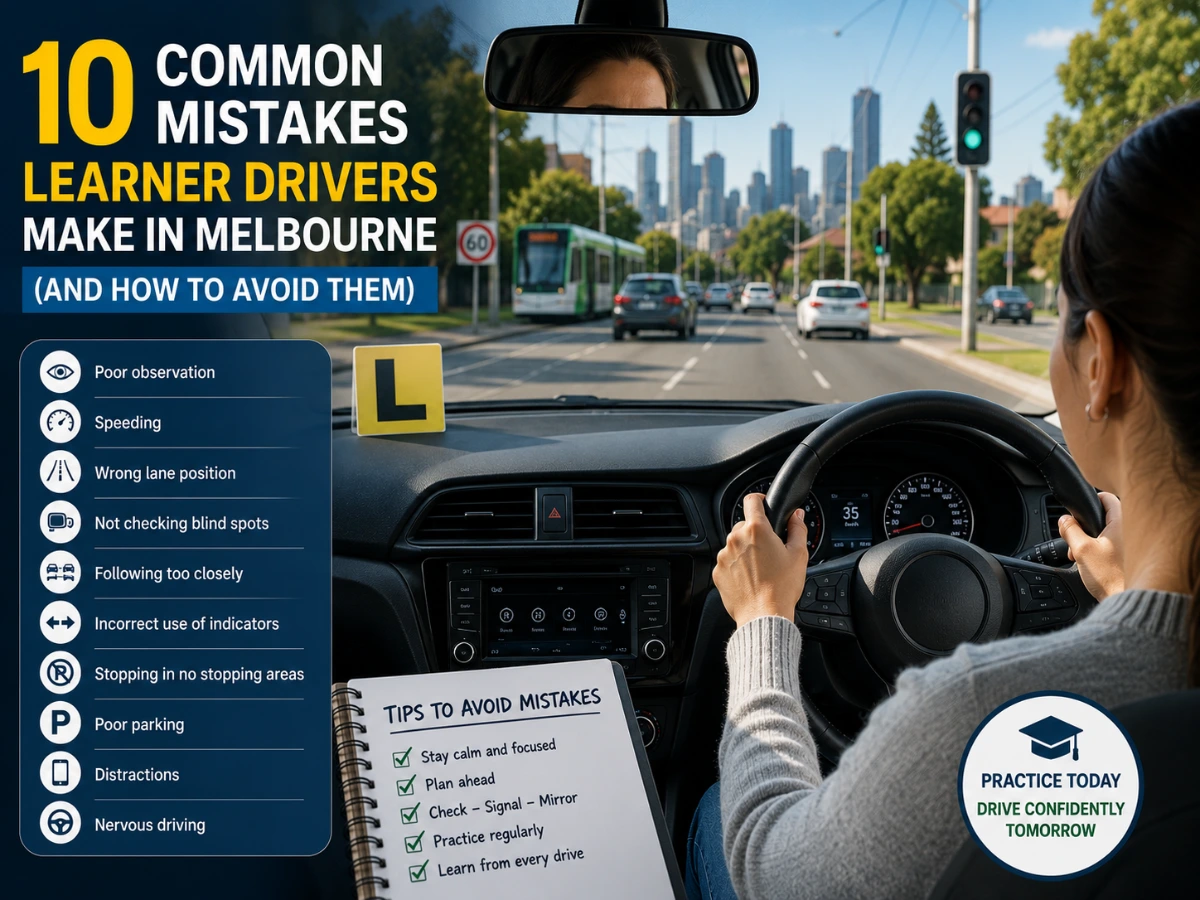
Summarize this post
Learning to drive in Melbourne is exciting, but it also comes with a learning curve. Every new driver makes mistakes, and that is completely normal. What matters is recognising those mistakes early and correcting them before your VicRoads driving test.
After years of teaching Melbourne learner drivers, the team at Licence Pass Driving School Melbourne has seen the same errors come up time and again. Here are the 10 most common ones and exactly how to avoid them.
1. Not Making Head Checks Visible Enough
This is the single most common reason learners fail the VicRoads drive test. Checking your mirrors is important, but examiners need to physically see your head move when you check your blind spots.
How to fix it: Practice making deliberate, obvious head movements every time you change lanes, pull out from a parked position, or approach an intersection. Make it a habit from day one.
2. Driving Too Slowly
Many learners assume driving slowly is always safer. In fact, driving more than 10 km/h below the posted speed limit is marked as a fault during the VicRoads test and can also create hazards for other road users.
How to fix it: Aim to drive at or close to the speed limit when conditions allow. Match the general flow of traffic where it is safe to do so.
3. Rolling Through Stop Signs
A rolling stop where your wheels never fully come to rest is an immediate test fail. Many learners do this without realizing, especially when the road ahead looks clear.
How to fix it: Treat every stop sign as a full stop. Count a beat in your head after stopping, check both directions, then proceed. Make it a deliberate habit every single time.
4. Forgetting to Cancel Indicators
After completing a turn or lane change, many learners forget to switch off their indicator. This confuses other drivers and is recorded as a fault during the drive test.
How to fix it: After every turn, check your indicator is off. Ask your instructor to specifically call this out when it happens until it becomes second nature.
5. Poor Roundabout Technique
Roundabouts are everywhere in Melbourne, and they trip up more learners than almost any other situation. Common errors include entering without giving way, not indicating when exiting, and misjudging gaps in traffic.
How to fix it: Always give way to vehicles already in the roundabout. Signal left when you are about to exit. Approach at a controlled speed so you have time to assess the situation properly.
6. Inconsistent Mirror Checking
Safe driving requires constant awareness of what is behind and beside you. Learners who only check mirrors when prompted by their instructor will not have the natural habit needed for independent driving.
How to fix it: Build a regular mirror-checking routine, roughly every 5 to 8 seconds on open roads, and before any change in speed or direction. Make it part of your natural driving rhythm.
7. Braking Too Late or Too Hard
Harsh, last-minute braking is a sign of poor hazard perception and road planning. It is uncomfortable, harder on the vehicle, and tells examiners you are not reading the road ahead.
How to fix it: Look further ahead, at least 10 to 15 seconds down the road. When you see a red light, stop sign, or pedestrian crossing, begin reducing speed early and smoothly.
8. Hesitating at Intersections
Being overly cautious at intersections is just as problematic as rushing. Excessive hesitation disrupts traffic flow and suggests to examiners that you lack confidence in gap selection.
How to fix it: Practice reading gaps in traffic and making decisions decisively. If a gap is safe, commit to it. If it is not, wait calmly for the next one.
9. Letting Nerves Take Over
Test-day nerves are real and completely understandable. But anxiety leads to rushed decisions, forgotten checks, and errors that would not happen in a regular lesson. Many learners drive better in lessons than in tests simply because of nerves.
How to fix it: Ask your instructor to run full mock test sessions before test day. At Licence Pass Driving School Melbourne, we simulate the complete test experience, so the real thing feels familiar rather than frightening.
10. Not Practising in Different Conditions
Learners who only practise on quiet streets or familiar routes often struggle when the test takes them somewhere less comfortable, a busy main road, a school zone, or an unfamiliar intersection.
How to fix it: Deliberately vary your practice environments. Drive in light rain, at dusk, on busier roads, and through different suburbs. VicRoads rewards drivers who can handle real-world conditions not just ideal ones.
Final Thoughts
Every one of these mistakes is fixable with the right instruction and consistent practice. Recognizing them is the first step. The second is working with a patient, experienced instructor who builds your genuine road sense, not just test-day technique.
At Licence Pass Driving School Melbourne, we focus on building real confidence and safe driving habits that stay with you long after your licence test. With over 5,000 happy students and a 95% first-time pass rate, we know what it takes to get you across the line. Book your first lesson today.
Frequently Asked Questions
Q: What is the most common reason for failing the VicRoads driving test?
The most common reason for failing the VicRoads driving test is not performing visible head checks. Examiners must clearly see you check your blind spots and mirrors before changing lanes, turning, or moving off.
Q: Is driving too slowly a fault in the VicRoads test?
Yes, driving significantly below the speed limit without a valid reason can result in a fault during the VicRoads driving test. Learners should drive at a safe speed that matches traffic conditions and the posted limit.
Q: Can nerves alone cause you to fail the driving test?
No, nerves alone do not cause you to fail the driving test. However, nervousness can lead to mistakes such as missed head checks, hesitation, or poor observation, which may affect your result.
Q: How many minor faults are allowed in the VicRoads drive test?
There is no fixed number of minor faults allowed in the VicRoads drive test. However, repeated minor errors can lead to a failed assessment, while a single critical error results in an immediate fail.
Q: How does Licence Pass Driving School Melbourne help learners avoid these mistakes?
Licence Pass Driving School Melbourne uses structured driving lessons and realistic mock driving tests to help learners correct common mistakes. Our VicRoads-accredited instructors provide personalised feedback to improve confidence and increase first-time pass rates.
On This Page
Related Topics
Ready to Pass Your Test? Book Your First Lesson Today
Ready to Pass Your Test? Book Your First Lesson Today
Why Choose Licence Pass for Driving Lessons in Melbourne?
Thousands of Melbourne learners trust Licence Pass for some of the most affordable, best-value driving lessons in the west without compromising on quality. Here’s what makes us a trusted driving school in Melbourne’s west.
Frequently Asked Questions
Get answers to common questions about driving lessons, bookings and test preparation in Melbourne.
No FAQs Available
Driving Tips, Road Rules & Learner Advice
Get practical driving tips, Victorian road rules, hazard perception advice and learner guidance to help you prepare for your licence test.

Best VicRoads Testing Locations Near Melbourne’s West (What to Expect)
Choosing the right driving test centre in Melbourne’s west can help you plan your test…
Converting an Overseas Licence to a Victorian Licence: Full Guide
You’ve landed in Melbourne, found a place to live, and now you’re wondering: can I…
L Plates to P Plates Victoria: Victoria’s Graduated Licensing System Explained
Getting a driver’s licence in Victoria isn’t a single event. It’s a journey through stages,…