
Automatic Driving Tips for Beginners: 10 Top Tips to Drive an Automatic Car
Book Your Lesson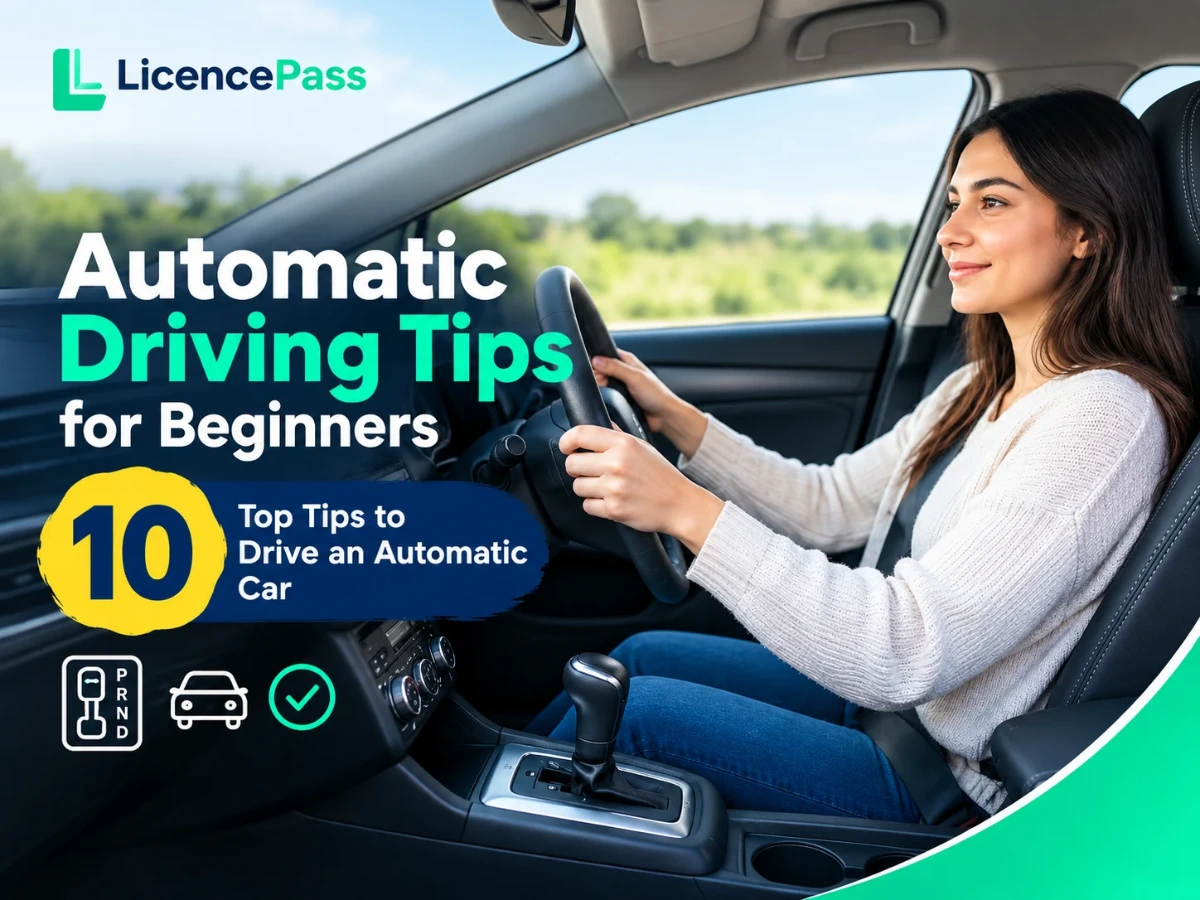
Summarize this post
Your first time behind the wheel can feel like a lot. There are mirrors to check, pedals to find, and a road full of other drivers. The good news is that an automatic car takes one big job off your plate. You do not need to work a clutch or change gear yourself, so you can focus on the road.
We wrote this guide for every beginner who wants to learn to drive an automatic. Below, we share 10 top tips, explain how the gearbox works, and cover common mistakes. If you want a driving instructor beside you for your first lesson, you can also look at the automatic driving lessons at Licence Pass.
What Is an Automatic Car and How Does It Work?
An automatic car changes gear for you. The gearbox reads your speed and the pressure on the accelerator, then selects the right gear without any input from you. Some newer models use a continuously variable transmission, which has no fixed gears at all. It slides smoothly through a range of ratios, so the ride feels seamless.
Automatic cars don’t have a clutch pedal. You have two pedals: the brake pedal on the left and the accelerator on the right. That is all you operate with your feet.
Manual or Automatic: Which Should You Learn First?
Many learners ask this question before their first lesson. Both options work, and each one has an advantage.
- Automatic: Easier to learn, less stress in stop-and-go traffic, and a quicker path to confidence on the road.
- Manual: More control over the engine, and a licence that lets you drive both types of car.
If you pass your test in an automatic, your licence usually limits you to automatic cars. If you pass a test in a manual car, you can drive both. Rules can differ by state, so check with your local licensing authority before you decide. Most beginners who want the simplest start prefer an automatic, and they can learn manual later.
Automatic Driving Tips for Beginners: 10 Top Tips
Tip 1: Set Up Your Seat and Mirrors Before You Start
Before you turn the key or press the start button, adjust your seat so you can reach the pedals without stretching. Your knees should bend a little. Then set your steering wheel, mirrors, and seatbelt. A good position helps you stay relaxed and in control.
Tip 2: Learn the Gear Selector First
The gear lever, also called the gear selector, has four main positions you must know:
- P (Park): The car is locked in place. Use it when you turn the engine off.
- R (Reverse): The car moves backwards.
- N (Neutral): The gearbox is disconnected. The car can roll freely.
- D (Drive): The car moves forwards and changes gear automatically.
Practise moving the lever through each position while the engine is off. This helps you remember where each one sits, so you do not look down on the road.
Tip 3: Keep Your Foot on the Brake When You Start
Always keep your right foot on the brake pedal before you move the gear lever out of Park. Most cars will not let you shift unless you press the brake. This is a safety feature, and it stops the car from moving by surprise.
Tip 4: Use Only Your Right Foot for Both Pedals
This is the tip we repeat most often. In an automatic, use your right foot for the brake and the accelerator. Keep your left foot on the floor or the footrest. If you use both feet, you may hit both pedals at once in a panic, and that can cause a hazard.
Tip 5: Press the Accelerator Gently
Automatic cars respond to the throttle quickly. A heavy foot can make the car surge forward, especially from a stop. Press the accelerator slowly and smoothly so your acceleration feels steady. The car will then change gears smoothly too, and the ride will feel calm for you and your passengers.
Tip 6: Understand Creep
Most automatic cars creep forward slowly when you take your foot off the brake in Drive or Reverse. This is normal. The engine sends a little torque to the wheels even without any gas. Creep is useful when you park or move through slow traffic, but always keep your foot ready to press the brake.
Tip 7: Brake Smoothly and Early
Look far ahead, and start slowing down early. Press the brake pedal gently, then add more pressure as you come to a complete stop. A late, hard stop can scare other drivers and shake your passengers. Smooth braking also helps your car use less fuel and wear its parts more slowly.
Tip 8: Never Shift to Park While the Car Is Moving
Always come to a complete stop before you select Park or change between Drive and Reverse. Changing gear while the car moves can damage the gearbox. A good habit is to stop, hold the brake, choose the gear, check around you, and then go.
Tip 9: Use Lower Gears and Modes When You Need Them
Automatic cars still give you some control. On long, steep descents, use a lower gear (often marked L, 2 or 1, or a manual shift mode) so the engine helps slow the car. Many models also offer driving modes such as Eco and Sport. Eco mode saves fuel and keeps the response calm, while Sport mode makes the car quicker to react. As a beginner, we suggest you stay in the standard mode or Eco.
Tip 10: Practise With a Driving Instructor
Reading helps, but real practice builds skill. A driving instructor can watch your feet, hands and eyes, and fix small habits before they become big ones. Short, regular lessons work better than one long session. If you want to know how long it may take, read our Licence Pass blog for more learner guides and advice.
How to Drive an Automatic Car: A Quick Step-by-Step
Here is a simple routine you can follow every time you drive.
- Adjust your seat, mirrors, and seatbelt.
- Press your foot on the brake pedal.
- Turn the key or press the start button.
- Keep your foot on the brake and move the gear lever to Drive.
- Check your mirrors, blind spots, and the road ahead.
- Release the brake slowly and let the car creep.
- Press the accelerator gently and steer smoothly.
- Slow down in good time, and stop with a firm, steady brake.
- Select Park, turn off the engine, and apply the handbrake if needed.
Common Mistakes Beginners Make in an Automatic
We see the same errors again and again. Knowing them helps you avoid them.
- Using the left foot to brake: Stick to your right foot only.
- Resting a foot on the brake while driving: This can wear the brakes and confuse drivers behind you, because your brake lights stay on.
- Pressing the accelerator too hard: Be gentle, especially in car parks.
- Shifting too early: Wait until the car stops completely.
- Forgetting the handbrake on a hill: Use it on slopes and when you park.
- Relying too much on the car: Cruise control and other features help, but you must still stay alert and watch for any hazard.
Driving in Different Road Conditions
An automatic car makes city driving easier, but road conditions still matter.
- Stop-and-go traffic: An automatic is ideal here, because you do not need to work a clutch again and again. Keep a safe gap and tap the brake lightly when you need to.
- Hills: Press the brake before you move off. Then release it slowly as you add gas, so the car does not roll back.
- Wet roads: Slow down, increase your following distance, and brake early.
- Highways: Merge smoothly with a firm press on the accelerator. A rapid but controlled build of speed helps you join traffic safely. Once you settle at the limit, you can use cruise control if your car has it and you feel ready.
Is a Test in an Automatic Easier Than a Manual Test?
Many learners think a test in an automatic is easier, and in one way it is. You do not worry about stalling or clutch control, so you can focus on the road rules, hazard checks and observation. However, the test standard stays the same. You still need to show safe, smooth and confident driving.
If you plan to take the test in an automatic, practise in the same type of car if you can. Use a car with similar controls so nothing feels strange on the day.
Final Thoughts
Learning to drive an automatic car does not have to feel scary. Set up your seat, learn the gear selector, use your right foot only, stay smooth on the pedals, and practise often. These top tips give you a strong start, and they work in every situation from quiet streets to busy roads.
At Licence Pass, we want every beginner to feel safe and confident behind the wheel. If you want a calm instructor and a clear plan for your first lesson, you can book with Licence Pass and start your driving journey the right way.
On This Page
Related Topics
Ready to Pass Your Test? Book Your First Lesson Today
Ready to Pass Your Test? Book Your First Lesson Today
Why Choose Licence Pass for Driving Lessons in Melbourne?
Thousands of Melbourne learners trust Licence Pass for some of the most affordable, best-value driving lessons in the west without compromising on quality. Here’s what makes us a trusted driving school in Melbourne’s west.
Frequently Asked Questions
Get answers to common questions about driving lessons, bookings and test preparation in Melbourne.
What if the car will not shift out of Park?
Check that your foot is firmly on the brake pedal. If it still will not move, look at your manual or ask a mechanic, because there may be a fault.
Is it safe to drive with my left foot resting on the brake?
No. Always use your right foot for both pedals, and keep your left foot still. This prevents you from pressing two pedals at once.
Can I switch to a manual car later?
Yes. Many drivers learn in an automatic first and move to a manual later. You will need to learn clutch control and gear changes, and you may need to pass a test in a manual car if you want a full licence for both.
Do automatic cars use more fuel?
Not always. Many modern automatic models are very efficient and can match or beat a manual. The result depends on the car, the gearbox type, and how you drive.
How many lessons do I need in an automatic car?
It depends on the person. Some learners feel ready after a few lessons, and others take longer. Your instructor can give you an honest idea after watching your progress.
Driving Tips, Road Rules & Learner Advice
Get practical driving tips, Victorian road rules, hazard perception advice and learner guidance to help you prepare for your licence test.
Automatic Driving Tips for Beginners: 10 Top Tips to Drive an Automatic Car
Your first time behind the wheel can feel like a lot. There are mirrors to…
How to Prepare Your Teen for Their First Driving Lesson In Melbourne
Your teen has their learner permit, the L plates are sitting in the glovebox, and…
Wet Weather Driving Tips for Melbourne Learners
Melbourne weather doesn’t ask permission. You can start a lesson in sunshine and finish it…