
Reverse Parallel Parking for Beginners: A Simple Step-by-Step Method
Book Your Lesson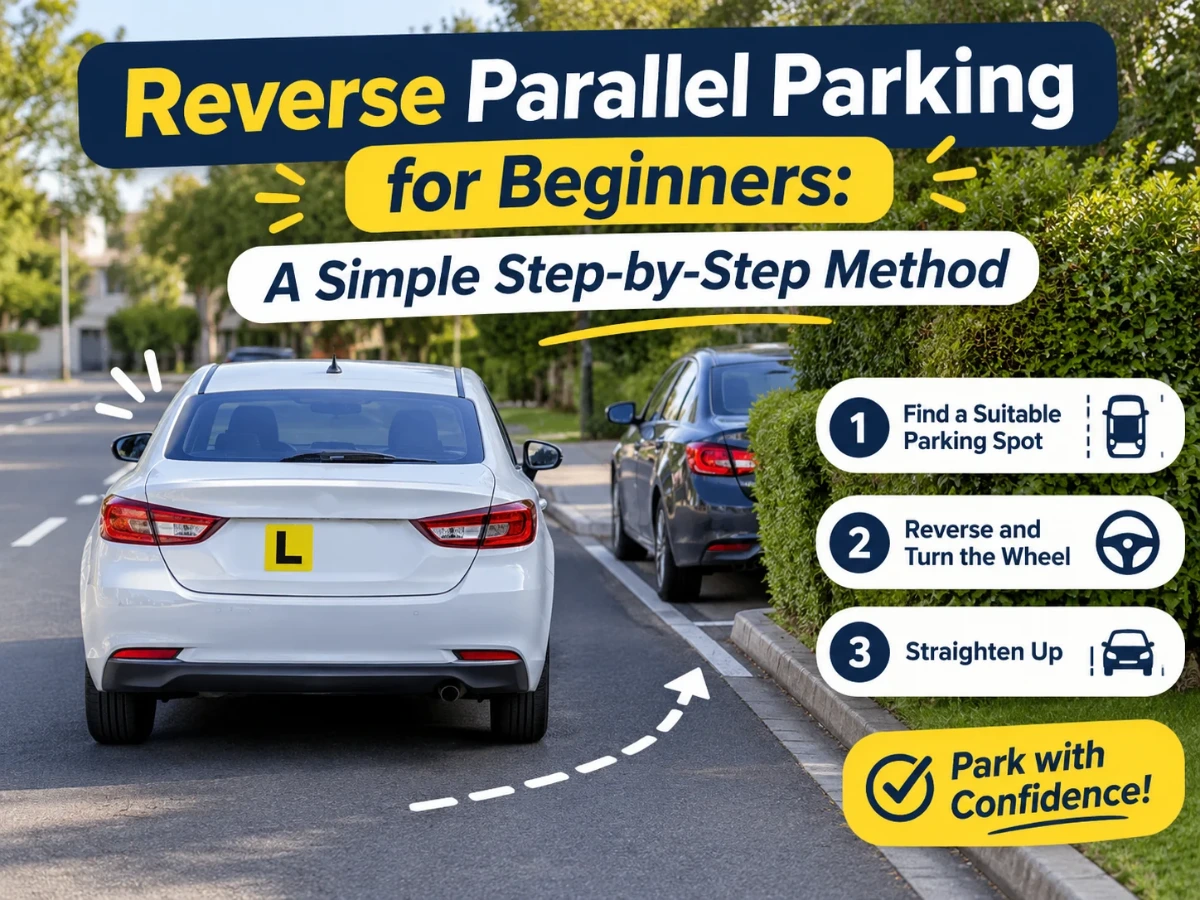
Summarize this post
Reverse parallel parking comes down to a few simple moves: signal and check, line up beside the car in front, steer into the space while reversing slowly, then straighten up and adjust. Take it slowly, keep looking all around, and let the vehicle do the work as you navigate tight parking situations.
If this manoeuvre makes your palms sweat, you’re in good company. It’s the one skill that asks you to steer, check three directions and judge a gap all at the same time. The good news is that it’s a method, not a talent. Once you know the steps and the common slip-ups, reverse parallel parking for beginners becomes a lot less scary.
Here’s a clear, beginner-friendly way to learn it.
What Is Reverse Parallel Parking?
Reverse parallel parking means reversing your car into a space at the side of the road, usually behind another parked car, so that you finish parallel to the kerb. In Victoria we drive on the left, so you’ll be parking on the left-hand side of the road.
It’s a standard skill for everyday driving, and it also shows up in the licence test (more on that below).
How Do You Reverse Parallel Park Step by Step?
This is the simple method most learners start with. Instructors sometimes use slightly different reference points depending on the car, so treat the markers below as a starting point and ask your instructor what works best for yours.
- Choose a space that’s big enough. Look for a gap of roughly one and a half car lengths. That’s a common guide, and your instructor can tell you what suits your car. For your first few attempts, pick a bigger space. There’s no need to squeeze into a tight one while you’re learning.
- Signal and check. Indicate left, check your mirrors and do a shoulder check. Then pull up alongside the parked vehicle in front of the parking space, leaving about a metre between the two cars.
- Line up beside the car in front. Stop with your rear bumper roughly level with the rear bumper of that car. Keep your wheels straight.
- Select reverse parking technique and check again. Look in your mirrors and over both shoulders, especially your right shoulder for traffic coming up behind you. If it’s clear, release the brake gently.
- Steer left and reverse slowly. Turn the steering wheel fully to the left, towards the kerb, and reverse at a walking pace. Your car will swing into the space at roughly a 45-degree angle. Keep going until you’ve cleared the back corner of the car in front.
- Straighten the wheel. While still rolling back slowly, turn the steering wheel fully to the right. The front of your car swings in towards the kerb and your car lines up with the road. Stop before you get too close to the car behind you.
- Adjust and finish. If you need to, roll forward or back a little to centre yourself in the space. Check that you’re parallel and close to the kerb without touching it. Then park the car, turn off your indicator and look for cyclists and traffic before opening your door.
Quick tip: Always check your surroundings before executing a parking maneuver. If something feels off while reversing, stop and reassess your position. Pull forward, reset and try again. A tidy second attempt beats a rushed first one every time.
What Are the Most Common Reverse Parallel Parking Mistakes?
Most beginners make the same few errors. Knowing them in advance saves a lot of frustration.
- Going too fast can hinder your ability to execute a proper parking maneuver. Speed leaves you no time to think or correct. Walking pace is the goal.
- Skipping observation. Relying on mirrors alone isn’t enough. Shoulder checks catch what mirrors miss.
- Starting too close to the front car. If you pull up too tight beside it, you won’t have room to swing in.
- Turning the wheel too early or too late. This is where reference points help.
- Ending up too far from the kerb. A wide gap makes the park look untidy and can leave your car sticking out into traffic.
- Clipping the curb is a common mistake to avoid. Slow, small adjustments at the end are better than one big correction.
- Giving up halfway. You can always stop, pull forward and start again.
What Are Some Reverse Parallel Parking Tips for Beginners?
A few habits make a big difference:
- Go slow. Slow is smooth, and smooth is accurate.
- Find your own reference points. Use a spot on your rear window or a mirror view that tells you when to turn the wheel for better positioning. Your instructor can help you find yours.
- Use your mirrors and shoulder checks together to enhance your parking technique. Mirrors help you judge distance, and shoulder checks cover the blind spots.
- Make small steering corrections. Big, jerky turns make the car harder to control.
- Practice one step at a time to master your parking technique. Get comfortable with the lineup first, then the angle, then the straighten-up.
- Stay calm. If a car pulls up behind you, finish your check and carry on safely. Nobody is judging your parking as much as you think.
How Do You Parallel Park in an Automatic Car?
The method is exactly the same, but you have fewer things to juggle. With no clutch or gear changes, you can put all your attention on steering and observation. In most automatic cars, the car creeps backwards when you release the brake, so you can control your speed with the brake pedal alone.
That’s one reason many learner drivers find an automatic vehicle easier to park. If you want to build confidence behind the wheel first, our guide to automatic driving tips for beginners is a good place to start. At Licence Pass, automatic driving lessons in Melbourne take place in a dual-control automatic car, so your instructor can help if you get stuck.
Is Reverse Parallel Parking Part of the Victorian Drive Test?
Yes, it can be. According to VicRoads, stage one of the drive test includes a low-speed parking manoeuvre, and the testing officer will ask you to complete either a reverse parallel park or a three-point turn. You won’t know which one you’ll get, so it’s worth practising both.
If you’re preparing for your driving test, ensure you practice your reverse parking. driving test preparation in Melbourne can help you practise the skills you’ll be assessed on. You may also want to read about the best VicRoads testing locations near Melbourne’s west so you know what to expect on the day.
How Can You Practise Reverse Parallel Parking?
Start somewhere quiet, such as a calm residential street or an empty car park, with a supervising driver beside you. Practise in short sessions rather than one long, tiring one. Even ten minutes of focused practice is more useful than an hour of frustration.
If you’re logging your hours, parking practice goes in your learner log book like any other driving. Our guide on how to log 120 hours in Melbourne explains how to make the most of that time.
New to driving altogether? First time driver lessons in Melbourne Start with the basics of reverse parking, so you’re not rushing into a parking space before you feel ready. And if nerves are the main problem, nervous driver lessons give you a calm, patient place to build confidence. Licence Pass instructor can guide you through reverse parallel parking at a pace that suits you.
Ready to Feel Confident Behind the Wheel?
Reverse parallel parking gets easier with patient practice and guidance from a driving instructor. If you’d like a hand, you can book a lesson with Licence Pass and work through it with an instructor beside you.
On This Page
Related Topics
Ready to Pass Your Test? Book Your First Lesson Today
Ready to Pass Your Test? Book Your First Lesson Today
Why Choose Licence Pass for Driving Lessons in Melbourne?
Thousands of Melbourne learners trust Licence Pass for some of the most affordable, best-value driving lessons in the west without compromising on quality. Here’s what makes us a trusted driving school in Melbourne’s west.
Frequently Asked Questions
Get answers to common questions about driving lessons, bookings and test preparation in Melbourne.
No FAQs Available
Driving Tips, Road Rules & Learner Advice
Get practical driving tips, Victorian road rules, hazard perception advice and learner guidance to help you prepare for your licence test.
Reverse Parallel Parking for Beginners: A Simple Step-by-Step Method
Reverse parallel parking comes down to a few simple moves: signal and check, line up…
Automatic Driving Tips for Beginners: 10 Top Tips to Drive an Automatic Car
Your first time behind the wheel can feel like a lot. There are mirrors to…
How to Prepare Your Teen for Their First Driving Lesson In Melbourne
Your teen has their learner permit, the L plates are sitting in the glovebox, and…